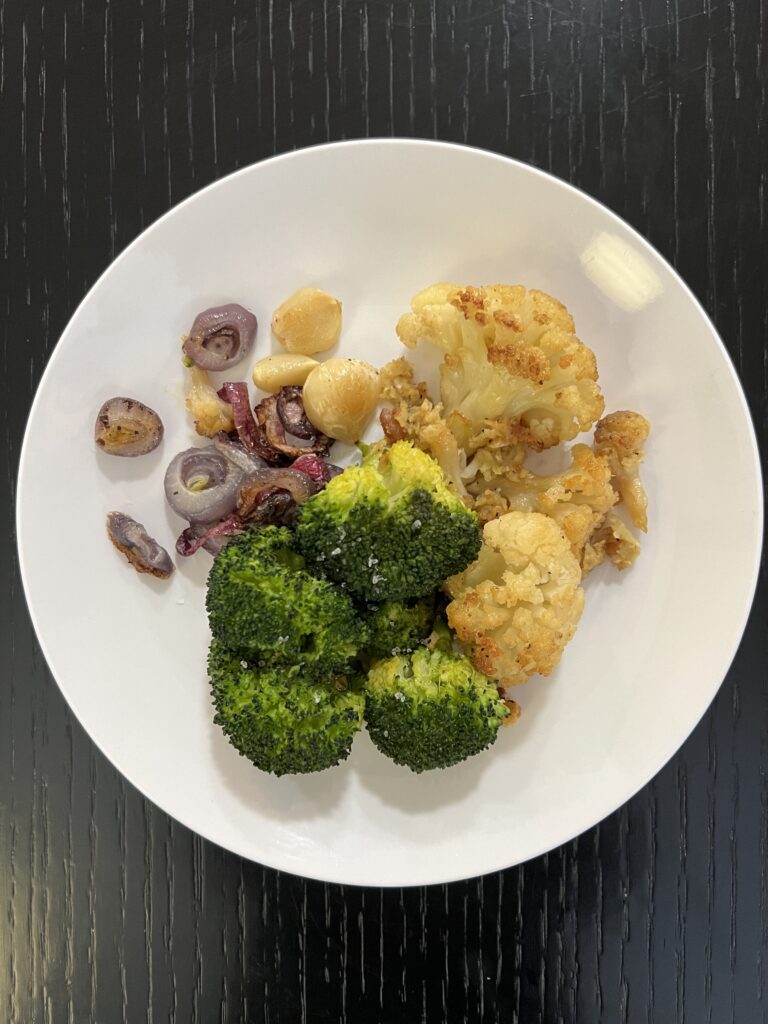
Quick answer: Yes—you can roast frozen vegetables straight from the freezer. For plain broccoli and cauliflower, a fully preheated 425–450°F oven, a light coating of oil, and a spacious single layer are useful starting points. Published manufacturer methods take roughly 20–25 minutes, but follow your package’s cooking requirements and check the vegetables rather than relying on the timer alone. (birdseye.com)
The aim is browned edges and a tender center—not necessarily the same texture as fresh vegetables. Freezing can rupture plant cell walls, so frozen produce may soften more readily even when you manage the roasting well. (extension.umn.edu)
Method note: The measured examples below adapt published cooking guidance. They have not been independently kitchen-tested for this article.
1. Why frozen vegetables turn watery instead of brown
Roasting needs dry heat at the vegetable’s surface. Browning reactions depend on heat, moisture, and time; an oven’s high temperature alone does not guarantee a browned result. Illinois Extension explains that dry-heat cooking encourages water evaporation and browning, unlike the wetter conditions of boiling or steaming. (extension.illinois.edu)
Frozen vegetables bring both frozen water within their tissues and, sometimes, ice on the outside. Freezing also changes their structure: expanding ice crystals can damage cell walls, leaving the vegetables softer once thawed. You cannot reverse that damage by roasting longer. (extension.umn.edu)
The practical response is to give moisture room to escape. Spread the pieces out rather than piling them together. Crowded vegetables tend to steam instead of roast; cooking the same crowded tray longer may produce increasingly soft vegetables without the browning you wanted. (nutritionletter.tufts.edu)
Before adding more time, check the arrangement: are pieces overlapping, or is there visible space between them? Fixing crowding is usually a more useful first adjustment than repeatedly stirring the same packed tray. (beaufort.ces.ncsu.edu)
2. Choose vegetables that can finish together
Broccoli and cauliflower are sensible starting choices because published manufacturer methods specifically cover roasting them from frozen. Plain florets also let you control the added oil and seasoning. (birdseye.com)
For other vegetables, use these selection checks:
| What is in the bag? | What to check before roasting |
|---|---|
| Broccoli or cauliflower florets | Look for reasonably similar piece sizes; check both the stems and the browned edges. |
| Carrots, potatoes, or winter squash | Dense pieces may need longer than softer vegetables. Follow product-specific directions. |
| A mixture of firm and soft vegetables | Consider separating the components or adding quicker-cooking pieces later. |
| Preseasoned or oven-ready vegetables | Check the directions before adding oil, salt, or changing the oven temperature. |
Vegetable density, softness, and piece size affect how evenly a tray cooks. General roasting guidance recommends uniform pieces and grouping vegetables with similar cooking times. Oven-ready products may already contain seasoning and have their own preparation method. (beaufort.ces.ncsu.edu)
A mixed bag is convenient, but it does not guarantee synchronized doneness. If one component repeatedly overcooks while another remains firm, use separate trays next time rather than looking for one perfect cooking time for the entire mixture. This is a practical application of the same grouping principle. (nutritionletter.tufts.edu)

3. Set up the oven and tray before opening the bag
Fully preheat the oven. Birds Eye publishes a 425°F method for frozen broccoli, cauliflower, and California blend, plus a separate 450°F broccoli method. Both are valid reference points; neither means every frozen vegetable should use the same temperature. (birdseye.com)
For the examples below, use:
- A sturdy, rimmed metal baking sheet, approximately 18 × 13 inches
- A large mixing bowl
- Measuring spoons
- A spatula and oven mitts
- A second baking sheet if the vegetables will not fit loosely
The pan dimensions are a specified setup for these examples, not a promise of capacity. Spacing decides whether the batch fits: each piece should sit on the pan, with visible gaps and no second layer. A sturdy rimmed sheet and uncrowded arrangement follow extension roasting guidance. (beaufort.ces.ncsu.edu)
Preheating the empty tray is optional, not essential. Some roasting methods use it to encourage browned edges, but the published frozen-vegetable methods cited here do not require that extra handling step. Beginners can start with a room-temperature sheet and a fully heated oven. (nutritionletter.tufts.edu)
4. Apply oil evenly, then spread the vegetables out
Toss the frozen vegetables with the measured oil in a bowl, then add the seasonings. Aim for a light, even coating rather than patches of oil on some pieces and none on others. North Carolina Cooperative Extension recommends bowl-tossing to distribute oil into the vegetables’ uneven surfaces without using too much. (beaufort.ces.ncsu.edu)
Do not assume more oil will fix a wet tray. Even coating and adequate spacing are separate jobs: oil helps with the roasting method, while space prevents the vegetables from being packed into steaming conditions. (beaufort.ces.ncsu.edu)
Add lemon juice, vinegar, fresh herbs, or a light finishing sprinkle of cheese after roasting. These are optional flavor choices, not required ingredients for browning. (nutritionletter.tufts.edu)
There is no need to turn salt timing into another complicated rule. The manufacturer examples used below season before roasting; University of Kentucky guidance instead suggests starting without salt for a crisper texture. Either approach can be tried, but first make sure the oven is hot and the tray is not crowded. (birdseye.com)
5. Measured examples for broccoli and cauliflower
These are two separate starting methods, not instructions to cook both trays together at different temperatures. Check your package first, especially for any required cooking method or final temperature.
Frozen broccoli at 450°F
Suggested yield: 4 side portions, each one-quarter of the batch
Preparation: About 5 minutes, plus oven preheating
Roasting: Approximately 20–25 minutes
Ingredients, in order of use
- 1 bag plain frozen broccoli, 16 ounces (454 g)
- 2 tablespoons olive oil
- ½ teaspoon salt
- Black pepper, to taste
The ingredient amounts and four-portion yield come from a UConn-hosted recipe that uses thawed broccoli. This example keeps those quantities but substitutes Birds Eye’s published roast-from-frozen temperature and timing; it is therefore an adaptation, not a reproduction of either method. (communitynutrition.cahnr.uconn.edu)
- Preheat the oven to 450°F.
- Toss the still-frozen broccoli with oil, salt, and pepper.
- Spread it loosely on the baking sheet; use another sheet if necessary.
- Roast, checking around 20 minutes. Look underneath a larger floret as well as at its tips.
- Continue toward 25 minutes as needed. The published quality cues are crisp-looking floret edges and browned bottoms. Complete any additional package-required cooking checks before serving. (birdseye.com)
Frozen cauliflower at 425°F
Suggested yield: 2 modest side portions, each half the batch
Preparation: About 5 minutes, plus oven preheating
Roasting: Approximately 23–25 minutes
Ingredients, in order of use
- 1 bag plain frozen cauliflower, 10.8 ounces (306 g)
- 1 tablespoon vegetable oil
- ¼ teaspoon salt
- Preheat the oven to 425°F.
- Toss the frozen cauliflower with oil and salt, then spread it in a single, uncrowded layer.
- Roast for 18–20 minutes, checking for substantial browning on the underside.
- Turn the pieces and roast for approximately 5 minutes more, checking tenderness and the package’s cooking requirements.
This example follows the manufacturer’s published quantities and method, with two suggested portions for meal planning rather than a claimed measured cooked yield. (birdseye.com)

6. Diagnose pale, uneven, or overcooked vegetables
Use the result to choose your next adjustment:
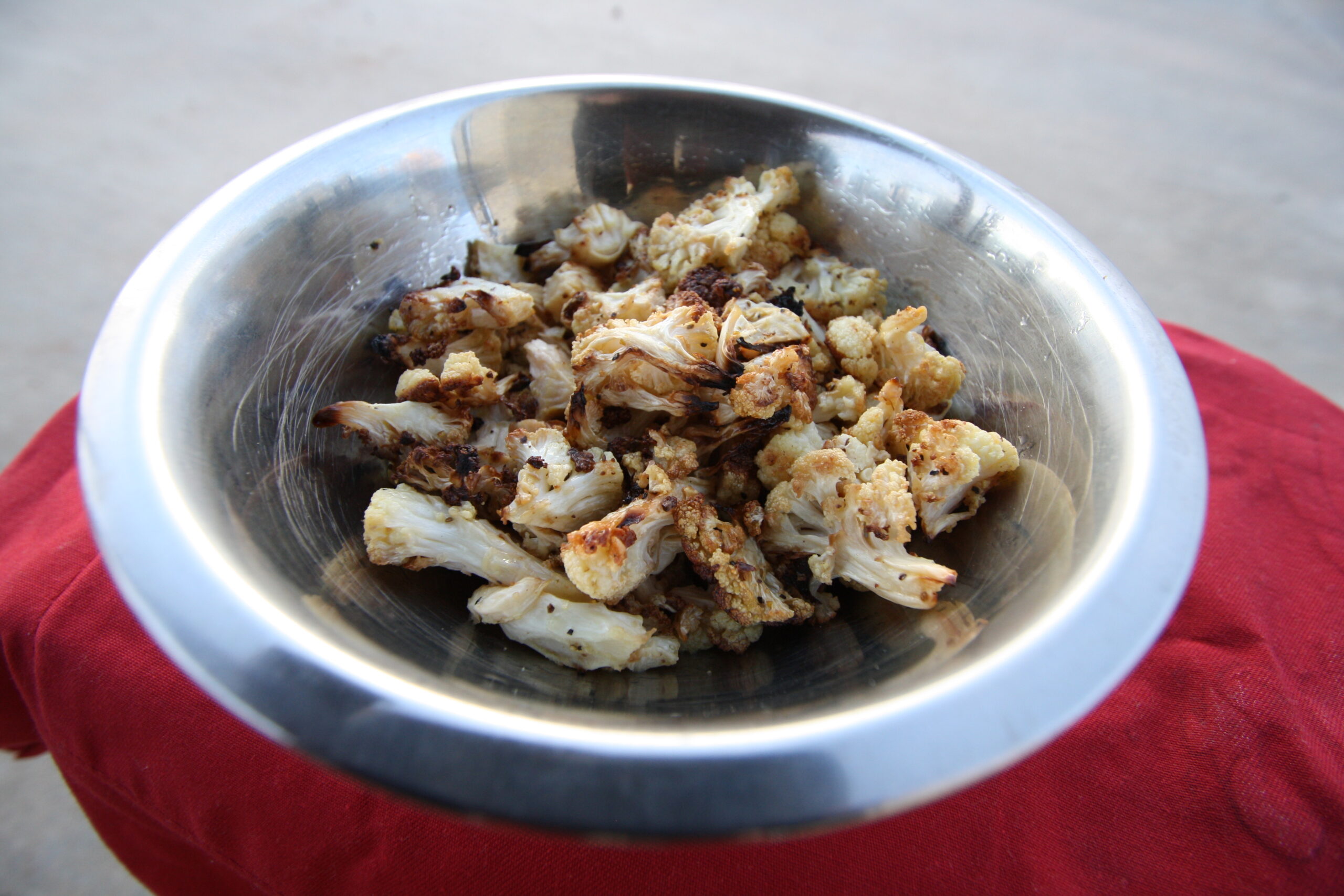
- Pale and soft: Check for overlapping pieces. Split the next batch across more tray space.
- Brown on one side only: Turn after the first side has browned rather than constantly stirring.
- Some pieces done, others firm: Check size differences and whether unlike vegetables were combined.
- Dark edges but an overly soft center: Do not keep roasting solely to chase more crispness. Frozen vegetables have structural limits that extra cooking cannot undo. (beaufort.ces.ncsu.edu)
For eating quality, check color and tenderness separately. Lift a piece to inspect its underside, then test a thick section with a fork. A browned tip does not tell you everything about the center. General roasting guidance calls for vegetables that are both browned and fork-tender. (nutritionletter.tufts.edu)
For safety, follow the package. Freezing does not reliably kill harmful bacteria, so do not treat frozen vegetables as automatically ready to eat or use browning as a substitute for the instructed cooking process. (extension.umn.edu)
7. When thawing is useful—and how to handle leftovers
Thawing is not always a mistake. It can be useful when a recipe deliberately calls for thawed vegetables and includes a drying step. The UConn-hosted broccoli recipe, for example, specifies thawed broccoli patted dry before oiling and roasting. Its timing should not be transferred unchanged to a frozen batch. (communitynutrition.cahnr.uconn.edu)
Choose one method deliberately: roast from frozen using appropriate guidance, or thaw and dry when the recipe requires it. Avoid combining the preparation from one recipe with the timing from another without allowing for the difference.
For leftovers, refrigerate in shallow containers within two hours, use within 3–4 days, and reheat to at least 165°F, following Illinois Extension’s leftover guidance.
For the next batch, note the vegetable, bag weight, oven setting, tray arrangement, and result. Change one variable at a time. That gives you a useful kitchen reference without assuming another brand’s florets—or another oven—will behave identically.